AI compliance, governance and the AI Act
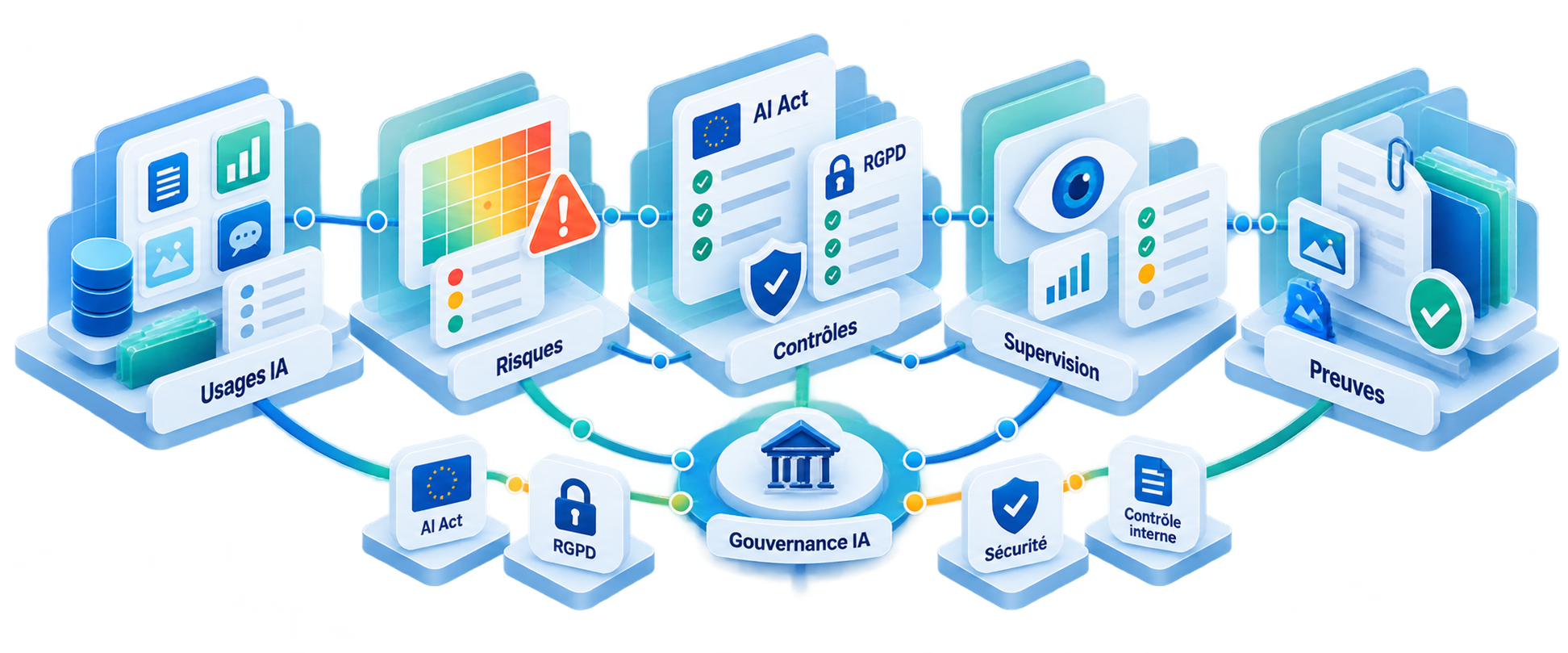
OLING helps organisations deploy AI without accountability blind spots by addressing the AI Act, data protection, human oversight, supplier management and compliance evidence.
We align governance, security, compliance, procurement and internal controls to make AI uses auditable and sustainable.
Scope of the engagement
- AI compliance assessment and mapping of AI uses.
- Assessment of risks, obligations and responsibilities.
- Definition of policies, controls and human oversight principles.
- Creation of an AI use register, evidence framework and supplier documentation.
- Alignment of the AI Act, GDPR, security and internal governance.
Expected deliverables
- AI use map and risk matrix.
- AI policy and governance framework.
- Compliance register and control points.
- Compliance action plan.
Scope of our engagement
- AI usage audit, inventory and system register
- Identification of regulatory roles and risk classification
- AI policy, permitted uses, responsibilities and committees
- AI Act assessment, data protection and appropriate impact assessments
- Supplier governance, access control and confidentiality
- Human oversight, auditability, incident handling and controls
- Support for an ISO/IEC 42001 management system
Deliverables and decision criteria
System register, obligations matrix, AI policy, risk assessment, control plan and evidence pack. Deadlines are established for each system according to its purpose, regulatory role and applicable provisions, with an accountable owner.
AI Act: classify obligations and deadlines
Regulatory reference checked on 23 October 2026: the AI Act generally applies from 2 August 2026, with specific provisions. Initial prohibitions and AI literacy apply from February 2025; GPAI obligations from August 2025. High-risk deadlines are 2 December 2027 (Annex III) and 2 August 2028 (Annex I products), under the updated rules. Each system still requires individual classification.
Prerequisites, controls and limitations
Compliance is not a label attached to a tool. It depends on use, data, actors and operations. ISO/IEC 42001 support is not certification. GDPR and cybersecurity obligations still require attention when a system is not classified as high-risk.
Discuss your AI projectOur method: from business need to measured value
Understand
Analyse the organisation, activities, people, data and IT landscape. Observe real work and pain points before selecting a solution.
Prioritise
Compare business value, feasibility and risk. Establish a baseline, a business owner and success criteria for each use case.
Design
Define the target process, architecture, interfaces, responsibilities, human approvals and performance indicators.
Experiment
Test a pilot on representative situations, including failure cases. Compare quality, cost and usefulness with agreed criteria.
Deploy
Integrate with applications, run acceptance and rollback checks, train users and support managers.
Measure
Track benefits, errors, costs, adoption and incidents. Regularly reassess models, data and controls.
FAQ
How can AI agents be deployed reliably?
Constrain tools and permissions, test adversarial and failure scenarios, require appropriate human approvals and monitor actions. An agent must be able to stop and hand a case to a person.
Bringing the right expertise together